Loading article
Loading page
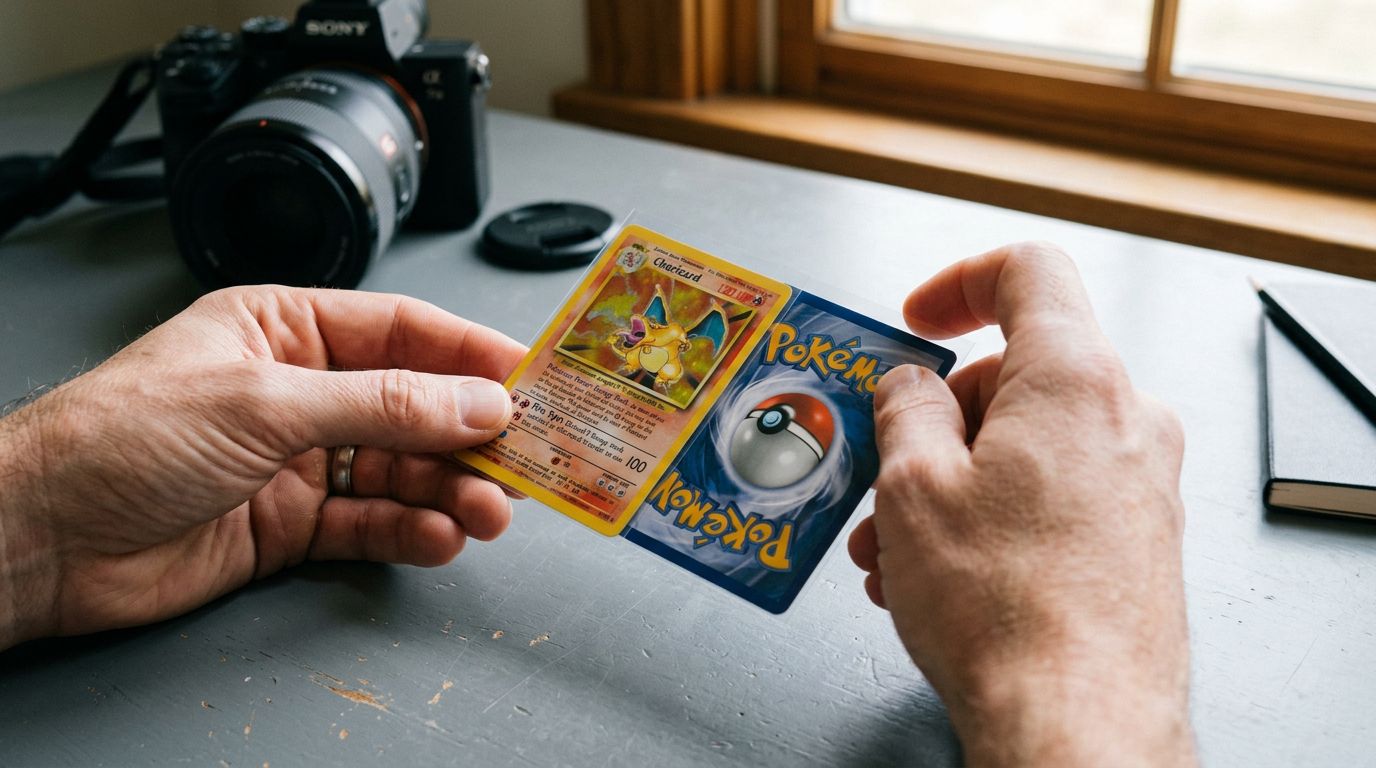
Centering is one of the easiest grading issues to see and one of the easiest to ignore.
A Pokemon card can have sharp corners, clean edges and a flawless-looking surface, but still miss a PSA 10 because the artwork is shifted too far left, right, up or down. That is why centering matters so much for collectors who buy raw cards with grading in mind.
Centering does not make a card rare. It does not make the artwork better. But it can change the grade, the resale value and the number of buyers willing to pay a premium.
Centering describes how evenly the printed card design sits inside the card borders.
On most Pokemon cards, you can judge centering by looking at the border thickness:
If the left border is much thicker than the right border, the card is off-center left to right. If the top border is much thinner than the bottom border, the card is off-center top to bottom.
The cleaner the card, the more centering matters. On a damaged card, wear is the bigger problem. On a near-perfect modern card, centering can be the flaw that separates a 10 from a 9.
PSA's grading standards describe a PSA 10 as a virtually perfect card. PSA also states that the image on a PSA 10 card must be centered within an approximate tolerance of 55/45 to 60/40 on the front and 75/25 on the reverse.
That does not mean every card inside that range automatically gets a 10. PSA also considers corners, surface, edges, gloss, focus, staining, print defects and overall eye appeal. But centering is one of the first things collectors check because it is visible before magnification.
You can read PSA's published standard on the official PSA Grading Standards page.
A 55/45 centering ratio means one side of the border is about 55 percent of the combined border width and the other side is about 45 percent.
In simple terms: the border can be slightly uneven, but not dramatically uneven.
For example, if the left and right borders together measure 10 units, a 55/45 split means one side is around 5.5 units and the other is around 4.5 units. That is still visually close. A 70/30 split is much more obvious and usually hurts grading potential.
Most collectors do not measure every card with tools. They learn to spot obvious imbalance first.
Front centering usually matters more visually because it affects the card's eye appeal. The front is what buyers see first in a slab, in a binder or in photos.
Back centering still matters. PSA and other grading companies check both sides. A card can look strong on the front but lose grade potential if the back is badly shifted.
When inspecting a raw card, always check the back. Many collectors get excited by a beautiful front, then forget that the back borders also count.
CGC also publishes centering expectations. Its CGC Cards Grading Scale says a CGC Pristine 10 has 50/50 centering, while a CGC Gem Mint 10 allows centering not to exceed about 55/45 on the front and 75/25 on the reverse.
That is why centering can matter even more if you are chasing a Pristine label. A card may be clean enough for a strong grade but not perfectly centered enough for the strictest top designation.
This is also why collectors should not compare only the number on a slab. PSA 10, CGC Gem Mint 10, CGC Pristine 10 and Beckett 10 can all behave differently in the market.
Start with the front of the card.
Hold the card straight, not tilted. Look at the left and right borders first, then the top and bottom. If one side is clearly thicker, the card may still be nice, but it may not be a strong PSA 10 candidate.
Then flip the card and do the same on the back.
Check:
A card can be off-center in more than one direction. Some cards are shifted left and up. Others have a twist or diamond cut where the borders are not parallel.
For low-value cards, eye inspection may be enough. For expensive raw cards, use a centering tool, ruler, scan or high-quality photo.
A centering tool is usually a clear overlay with measurement guides. It helps estimate border ratios more consistently than guessing. Scans can also help because you can zoom and compare borders on a straight image.
If you are buying online, ask for straight photos of the front and back. Avoid judging centering from angled, blurry or heavily cropped photos.
Modern Pokemon cards often have full art, texture, silver borders, irregular art boxes or visual effects that make centering harder to judge. Some Special Illustration Rare cards do not have the same easy border structure as older cards.
That does not mean centering is irrelevant. It means you may need to judge the whole printed design rather than only a simple yellow border.
For modern cards, look at:
Eye appeal matters because buyers care about how the card looks, not only how it measures.
Many collectors open a pack, pull a clean chase card and assume it has PSA 10 potential. Then they notice the left border is too thick or the back is shifted.
That card may still be near mint. It may still be valuable. It may still look great in a binder. But grading is stricter than casual condition language.
A card can miss a 10 because of:
Centering is only one category, but it is one of the most common reasons a nice raw card does not become the grade a collector hoped for.
Centering affects resale in two ways.
First, it affects grade potential. A card that cannot realistically grade a 10 may not deserve a raw "PSA 10 candidate" premium.
Second, it affects eye appeal. Even inside the same grade, buyers may prefer the better-centered copy. Two PSA 10 cards can sell differently if one looks balanced and the other barely passes centering tolerance.
This is especially true for expensive Pokemon, popular alternate arts and vintage cards where collectors inspect every detail.
Yes, if the price matches the card.
An off-center card can still be a great binder card. It can still be a good collection piece. It can still be worth buying if you love the artwork or the price is fair.
The mistake is paying a grading-premium price for a card that is visibly unlikely to grade well.
Buy off-center cards when:
Avoid overpaying when a seller uses phrases like "pack fresh" or "mint" but the centering is visibly weak.
Centering is not the whole grade, but it is one of the fastest ways to judge whether a raw Pokemon card has serious PSA 10 potential.
If you collect for binders, buy the card you enjoy. If you collect for grading, be stricter. A beautiful card can still be a weak grading play if the borders are off.