Loading article
Loading page
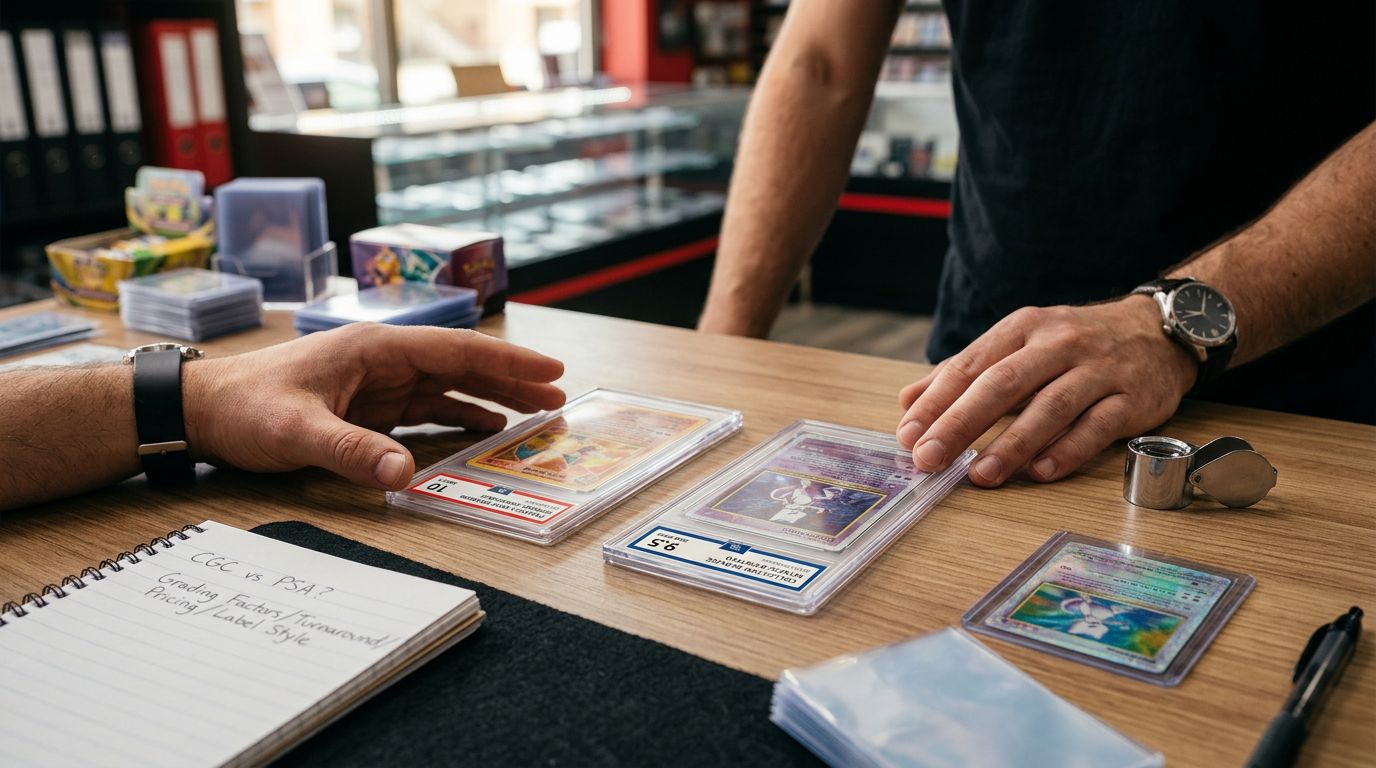
Grading is one of the biggest decisions in Pokemon TCG collecting. It can protect a card, authenticate it, make it easier to compare, and sometimes increase its market value. It can also be expensive, slow, and disappointing if the card comes back lower than expected. The strongest collectors do not grade everything. They learn when grading has a reason.
This guide explains how to think about PSA, CGC, card condition, grading economics, and collector value. It also covers a practical alternative: buying or opening into already graded cards, which is one reason TOKIO can be useful for collectors who want the slab experience without doing every submission themselves.
Professional grading turns a raw card into an authenticated, encapsulated collectible. A grading company reviews the card, assigns a condition grade, labels it, and seals it in a protective holder. For Pokemon cards, collectors often call these holders slabs.
A slab can help in four ways. It gives the card a condition reference, makes the card easier to display, protects it from normal handling, and gives future buyers more confidence that the card is authentic and accurately described.
That does not mean grading creates value automatically. A low-value modern card in a mid grade may be worth less than the grading fee. A card with sentimental value may be worth grading even if the math is not perfect. The right answer depends on the card, the condition, the cost, and your reason for owning it.
PSA and CGC both use 10-point grading systems, but collectors should understand the details before assuming every 10 means the same thing.
PSA describes a Gem Mint 10 as a virtually perfect card with sharp corners, sharp focus, full original gloss, no staining, and front centering that does not exceed roughly 55/45 to 60/40. PSA also says grading includes objective factors like print defects, staining, surface wrinkles, and centering, while eye appeal can still require judgment.
CGC uses its own 10-point scale for TCG, sports, and non-sports cards. CGC reserves Pristine 10 for cards that are flawless under 10x magnification. CGC Gem Mint 10 is still a top-grade card, but one grading criterion does not meet the Pristine 10 requirement. CGC also describes centering, corners, surface, gloss, color, and registration as part of the grade.
The important lesson is not that one company is always better. The lesson is that each slab is a market object. Some collectors prefer PSA liquidity. Some prefer CGC labels, submarket pricing, or Pristine 10 upside. Before you submit or buy, check how your exact card sells in the holder you are considering.
Most bad grading decisions start with overconfidence about condition. Pokemon cards can look clean in a sleeve and still miss a high grade. Before submitting, inspect the card under bright, angled light and look at both sides.
Check these areas first:
A small flaw matters more when you are chasing a 10. A card can be beautiful in a binder and still not be a good grading candidate.
Grading makes the most financial sense when the expected graded value is higher than the raw value plus all costs. Those costs include grading fees, shipping, insurance, supplies, possible membership fees, time, and the risk that the grade is lower than expected.
A simple formula helps:
Expected graded value minus raw value minus grading costs equals your likely grading edge.
If that number is small or negative, grading is probably not a financial move. It may still be a personal collection move, but you should be honest about which one it is.
Grade when one or more of these are true:
Avoid grading when the card only looks good in a dark photo, when the raw value is low, when you are relying on hype, or when the card needs a perfect 10 just to break even.
Modern Pokemon cards can look incredible. Special illustration rares, textured cards, full arts, and chase cards often feel like obvious grading targets. But modern supply can be large, and many collectors submit the same cards at the same time.
That means the market can get crowded. A modern card in PSA 9 or CGC 9 may not carry enough premium to justify the grading cost. Even a 10 can fall if many copies enter the market.
For modern cards, be stricter. Only grade if the card is exceptionally clean, the character demand is strong, the raw price supports the math, or the card matters to your personal collection.
Not every card decision needs to be an investment decision. Some cards deserve slabs because they mean something.
A childhood Charizard, a favorite Pokemon, a card pulled with a friend, a first big chase card, or a clean copy from a completed set can be worth grading because the slab turns it into a permanent display object. In those cases, the grade still matters, but it is not the only thing that matters.
The best emotional grading rule is simple: if the card came back lower than expected, would you still be happy to own it in a holder? If yes, grading can make sense. If no, you may be submitting for the wrong reason.
Submitting raw cards is not the only way to collect slabs. Sometimes it is smarter to buy or open into already graded cards.
Already graded cards remove much of the uncertainty. You can see the grade, compare the slab to recent sales, and decide whether the price fits your collection before committing. You do not have to guess whether a raw card will receive a 10. You do not have to wait through a submission. You do not have to manage shipping and insurance for cards you are not sure about.
This is also where TOKIO has a clear collector use case. TOKIO is built around opening pack tiers, revealing graded cards, and building a vault around real collectible inventory. For someone who likes the excitement of pack openings but wants the clarity of slabs, ready graded cards can be a strong middle ground. You still get the reveal, but the asset is already easier to understand, display, track, and eventually hold, sell, or redeem.
That does not replace traditional collecting. It gives collectors another path. Some people like raw binder building. Some like submitting cards themselves. Some want the finished slab experience from the start.
Think of the three paths differently.
Raw cards are best for binder building, set completion, lower-cost collecting, and learning condition. Graded cards are best for display, authentication, higher-value cards, and condition certainty. Ready graded reveal experiences are best when you want the excitement of opening with clearer asset information afterward.
A balanced collector can use all three. Build raw binders for joy. Buy singles for specific goals. Grade only the cards that deserve it. Use graded-card pack experiences when you want a slab-focused reveal without doing the full submission workflow yourself.
Before sending a Pokemon card to PSA, CGC, or another grader, ask:
If you cannot answer those questions, wait. Waiting is one of the cheapest skills in collecting.
Grade fewer cards, but choose better cards.
The strongest Pokemon collections are not built by submitting every shiny pull. They are built by understanding condition, buying patiently, protecting cards properly, and knowing when a slab actually improves the card. Grading can be powerful, but only when it serves a clear purpose.
If your goal is to learn, start with raw cards. If your goal is display and certainty, buy or open into graded cards. If your goal is long-term collecting, combine both approaches and let each card earn its place.