Loading article
Loading page
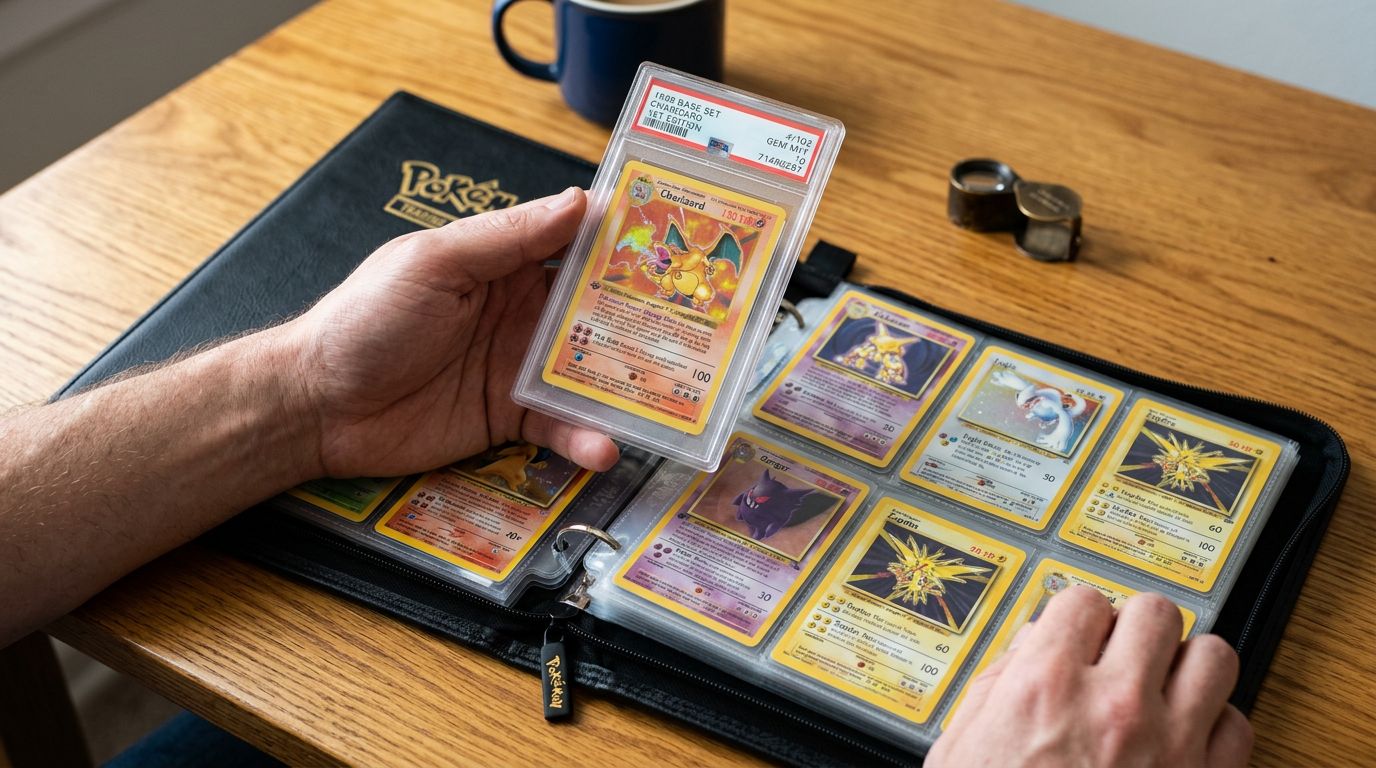
One of the biggest decisions in Pokemon card collecting is whether to buy raw cards or graded cards.
A raw card is not professionally graded. It may be in a sleeve, binder, top loader or card saver, but it has not been authenticated, graded and sealed inside a slab by a grading company.
A graded card has been reviewed by a third-party grading company such as PSA, CGC or Beckett, assigned a grade and sealed in a tamper-evident holder. For collectors, that slab changes how the card is bought, sold, displayed and valued.
Neither option is always better. Raw cards and graded cards solve different problems.
A raw card is simply an ungraded card. Most Pokemon cards in the world are raw.
Raw cards are popular because they are usually cheaper than high-grade slabs, easier to store in binders and more flexible for collectors who enjoy building complete sets. If you like flipping through pages, organizing by set number or collecting artwork, raw cards can be more enjoyable.
The downside is uncertainty. A seller may call a card near mint, but your definition of near mint may not match theirs. Photos can hide surface scratches, dents, whitening, print lines or small bends. A raw card can look clean online and still grade lower than expected.
A graded card is a card that has been authenticated, evaluated and encapsulated by a grading company. The label usually shows the card name, set, card number, grade and certification number.
The grade gives the market a shared language. A PSA 10, CGC Pristine 10 or Beckett Black Label 10 tells buyers that the card has been judged against a formal standard, even though grading still includes some human judgment.
Graded cards are popular because they offer:
The tradeoff is price. You are not only paying for the card. You are also paying for the grade, the authentication, the slab, the grading fee history and the market demand for that exact grade.
A graded card can command a premium because buyers are paying for reduced uncertainty.
For example, many raw modern cards look clean at first glance. But only a smaller percentage may be strong enough for a top grade after checking centering, corners, edges and surface. If a popular card is difficult to find in PSA 10, CGC Pristine 10 or Beckett 10 condition, the graded premium can become large.
That premium usually depends on:
A graded card is not automatically a good deal. A common card in a low grade may be worth close to raw value, or sometimes less than the grading cost.
Raw cards are often better when you want affordability, binder collecting or upside from finding clean copies.
Raw makes sense when:
Raw cards can also be better for casual collectors. Not every card needs to be slabbed. A beautiful illustration rare in a binder can be more enjoyable than the same card locked in a case if your goal is personal collecting rather than resale.
Graded cards are often better when condition, authenticity and resale confidence matter.
Graded makes sense when:
This is also where TOKIO becomes useful for collectors. Opening ready-graded cards removes the normal raw-card question of "what condition did I actually get?" You still need to understand market value, but the card is already authenticated, graded and slabbed, so the reveal is clearer than opening raw packs where every hit must still be inspected.
The biggest raw-card risk is hidden condition.
A raw card can have:
These flaws can make a big difference. A card that looks near mint in a listing might not be a strong grading candidate. If you are buying raw because you hope it will grade a 10, you need to be stricter than a normal binder collector.
The biggest graded-card risk is overpaying for the label.
A slab does not make every card rare. If a card has a huge population in PSA 10, the premium may be limited unless demand is also very strong. If a card is unpopular, even a high grade may not create much liquidity.
There is also label preference. PSA, CGC and Beckett can all be respected, but the market may price the same card differently depending on the grading company and grade. A PSA 10 may sell differently from a CGC Gem Mint 10. A CGC Pristine 10 or Beckett Black Label 10 may carry a different premium because those labels represent stricter or more specialized top-end outcomes.
PSA is the most widely recognized grading company for many Pokemon collectors. PSA's public grading standards describe a PSA 10 as a virtually perfect card with sharp corners, original gloss and strict centering tolerance.
CGC uses a 10-point scale and separates Gem Mint 10 from Pristine 10. CGC describes Pristine 10 as reserved for cards that are among the best of the best, while Gem Mint 10 is still a top overall grade but does not meet every Pristine requirement.
Beckett is known for subgrades and the famous Black Label 10. A Beckett Black Label means the card received perfect 10 subgrades across the grading categories. A Beckett Pristine 10 with a regular label can still be extremely strong, but Black Label is the collector phrase people usually associate with the very top Beckett result.
For buying decisions, the key point is simple: do not compare only the number. Compare the company, label, population, sale history and collector demand.
Before buying, compare three numbers:
If a raw card costs $80 and a PSA 10 sells for $180, that does not automatically mean the raw card is a good grading play. You still need to consider grading fees, shipping, insurance, turnaround time, taxes, the chance of getting a 9 instead of a 10 and the possibility that market prices move while the card is away.
For price research, collectors often check recent sales and market tools such as PriceCharting, TCGplayer, eBay sold listings, PSA Auction Prices and population reports from grading companies.
Buy raw when you want the card for your binder, when the graded premium is too high, or when you trust your ability to inspect condition.
Raw is also the better choice for many lower-value cards. If the card is inexpensive, grading may cost more than the value it adds. In that case, a clean raw copy can be the smarter collectible.
Buy graded when the card is expensive enough that condition confidence matters. Graded also makes sense when you want a specific grade, want a display piece or want easier resale later.
For high-end Pokemon cards, grading can make the market more transparent. A buyer can still disagree with a grade, but a slab gives both sides a clearer starting point than vague words like mint, pack fresh or clean.
If you collect for binders, artwork and set completion, raw cards are often the better experience. If you collect for condition, authentication, display and resale clarity, graded cards are often the better choice.
The strongest collection can include both. Raw cards give you flexibility and affordability. Graded cards give you confidence and structure. The important part is knowing why you are buying each card before you pay the premium.