Loading article
Loading page
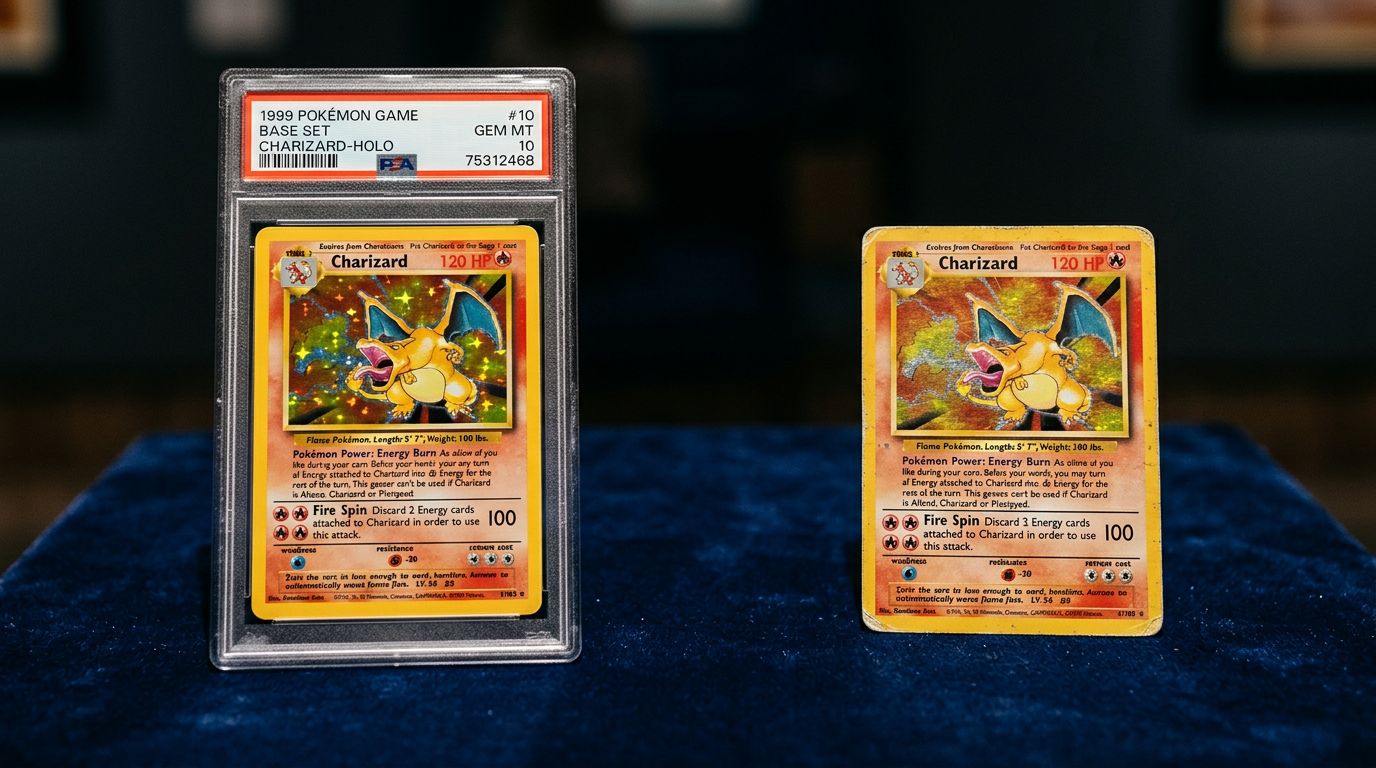
A PSA 10 Pokemon card can be worth dramatically more than the same card raw, in PSA 9, or in lower grades. That premium is why collectors chase Gem Mint copies, why sellers advertise PSA 10 so heavily, and why beginners sometimes assume every clean-looking card should be graded.
But a PSA 10 is not valuable just because the label says 10. The value comes from the exact card, the character, demand, condition scarcity, population data, recent sold prices, and how the grade compares with other premium grading outcomes like BGS Black Label and CGC Pristine 10.
This guide explains what a PSA 10 means, why some PSA 10 Pokemon cards sell for huge premiums, when the premium is justified, and why not every card is worth grading.
PSA 10 is PSA’s Gem Mint grade. PSA describes a Gem Mint 10 card as virtually perfect, with sharp corners, sharp focus, original gloss, no staining, and centering within PSA’s published tolerance.
That does not mean every PSA 10 is literally flawless under extreme magnification. It means the card met PSA’s Gem Mint standard. This distinction matters because different grading companies use different standards, labels, and market expectations.
For Pokemon collectors, PSA 10 usually signals:
PSA 10 is popular because the market understands it. Liquidity is one of PSA’s biggest advantages.
A PSA 10 premium is usually driven by condition scarcity. Many Pokemon cards look clean in a sleeve, but far fewer survive grading with no meaningful corner, edge, surface, centering, or print issues.
The premium can be especially strong when the card has:
A vintage holo is a good example. Many copies were handled by kids, stored in binders, played without sleeves, or scratched over time. A clean PSA 10 copy can be rare because condition is genuinely scarce.
Modern cards are different. They may be pulled straight into sleeves, submitted in large numbers, and have high PSA 10 populations. Some modern PSA 10s still command premiums, but the math depends heavily on demand and population.
A population report shows how many copies of a card have been graded at each level by a grading company. For PSA cards, the PSA Population Report is one of the key research tools collectors use.
Population data helps answer questions like:
A low population can support a premium, but it does not guarantee one. A card can be low-pop because nobody cares enough to submit it. A card can be high-pop and still valuable because demand is massive.
Population is supply data. Value still needs demand.
The PSA 10 versus PSA 9 gap is one of the most important things to check before grading or buying.
Sometimes the gap is small. A PSA 10 might sell only slightly above PSA 9, especially for lower-demand modern cards. In that case, grading raw copies may not be worth the cost unless the card is very clean and inexpensive to submit.
Sometimes the gap is huge. A PSA 10 of a major vintage holo or elite chase card can sell for multiples of PSA 9 because the top grade is much harder to find.
Before grading, ask:
If only PSA 10 makes the math work, the submission is riskier than it feels.
Many beginners overgrade. They pull a shiny card, assume it looks perfect, and send it in. The problem is that grading fees, shipping, insurance, time, and downside risk all matter.
A card may not be worth grading if:
Modern Pokemon cards can be beautiful without being good grading candidates. A card should earn the submission.
A strong grading candidate is not just clean. It is clean and worth grading.
Look for:
Use angled light. Surface dents are one of the easiest flaws to miss. A card can look perfect in a sleeve and still fail to reach Gem Mint because of one tiny dent.
Do not use one asking price. Use recent sold listings and compare the exact card.
A practical PSA 10 value check looks like this:
A PSA 10 value is strongest when multiple sales support it, demand is real, and the population is not exploding faster than buyer interest.
BGS Black Label is often treated as one of the most elite outcomes in card grading. In collector language, a BGS Black Label 10 generally means the card received perfect 10 subgrades across Beckett’s main grading categories: centering, corners, edges, and surface.
That makes BGS Black Label different from a normal PSA 10. PSA 10 is Gem Mint under PSA’s grading standard. BGS Black Label is a stricter perfect-subgrade outcome under Beckett’s system.
For high-end Pokemon cards, a BGS Black Label can command a major premium because collectors see it as a near-perfect or perfect-condition flex. But Black Label liquidity can vary by card. Some buyers prefer PSA because PSA has broader market recognition. Others will pay more for Black Label rarity.
The key lesson: BGS Black Label is not simply another version of PSA 10. It is a different grading-company outcome with a different buyer base.
Collectors sometimes mix up Beckett label types. The important difference is this:
BGS Black Label 10 is the top Beckett outcome tied to perfect 10 subgrades across all major categories. A standard BGS Pristine 10 can still be extremely strong, but it is not the same thing as Black Label if one subgrade is below perfect.
In simple terms:
Collectors may use casual phrases like black label, gold label, silver label, or white label depending on label generation, sport/card category, or how they describe the slab visually. For value, do not rely on color slang alone. Read the grade, subgrades, cert details, and recent sold comps for that exact label type.
CGC has its own grading scale. CGC describes Pristine 10 as reserved for cards that are flawless under 10-times magnification, with 50/50 centering and flawless color and registration. CGC also has Gem Mint 10, which is still a 10 overall but does not meet one of the Pristine 10 requirements.
That means CGC Pristine 10 is not the same category as CGC Gem Mint 10. It is also not the same as PSA 10. Each company has its own standard, label, population, and buyer base.
A CGC Pristine 10 can be very desirable when collectors trust the grade, the card is high demand, and the Pristine population is low. But PSA 10 may still sell more easily for some cards because PSA has broader Pokemon-market liquidity.
The best comparison is not theoretical. Check sold prices for the exact card in PSA 10, CGC Pristine 10, CGC Gem Mint 10, BGS Pristine 10, and BGS Black Label 10 if enough sales exist.
There is no universal answer.
PSA 10 is often strongest for liquidity and broad market recognition. BGS Black Label is often strongest for the perfect-subgrade prestige. CGC Pristine 10 can be very attractive for collectors who like CGC’s stricter Pristine designation and label system.
For many Pokemon cards, the market hierarchy depends on actual buyer demand. A famous card with a tiny BGS Black Label population may sell above PSA 10. A common modern card may move faster in PSA 10 because more buyers search PSA first. A CGC Pristine 10 may outperform a CGC Gem Mint 10 but still need the right buyer.
Use data, not assumptions.
A raw card is an estimate. A PSA 10 is a confirmed market category.
That is why the same card can change value so much after grading. The buyer no longer has to guess whether the card is clean enough. The grade creates confidence and makes comparison easier.
But raw cards can still be the smarter buy if:
The slab adds certainty, but certainty has a price.
TOKIO is useful because collectors increasingly want clear asset context after a reveal. A card is not just a name and picture. Its grade, condition, estimated value, vault status, and ownership options all matter.
That is especially true with PSA 10s, BGS Black Labels, CGC Pristine cards, and other premium slabs. The label changes how collectors think about the card. It can affect display value, resale value, and whether someone wants to hold, sell, redeem, or track it long-term.
TOKIO’s graded-card reveal and collection workflow fits this collector behavior. It helps move the experience from random opening to clearer ownership: what did I pull, what grade is it, what is it likely worth, and what can I do next?
Pay the premium when the card deserves it and the data supports it.
A PSA 10 premium is easier to justify when:
Be careful when:
A PSA 10 is a grade. It is not a guarantee of future value.
A PSA 10 Pokemon card is worth what the market pays for that exact card, in that exact grade, at that moment. The grade matters, but it is only one part of the value equation.
The strongest PSA 10s combine clean condition, real demand, low or meaningful high-grade supply, strong artwork, and consistent sold prices. BGS Black Label and CGC Pristine 10 add even more nuance because they represent different premium-grade outcomes with different buyer bases.
Do not grade every clean card. Do not overpay for every 10. Learn the card, check the population, compare the sales, and make the grade earn the premium.