Loading article
Loading page
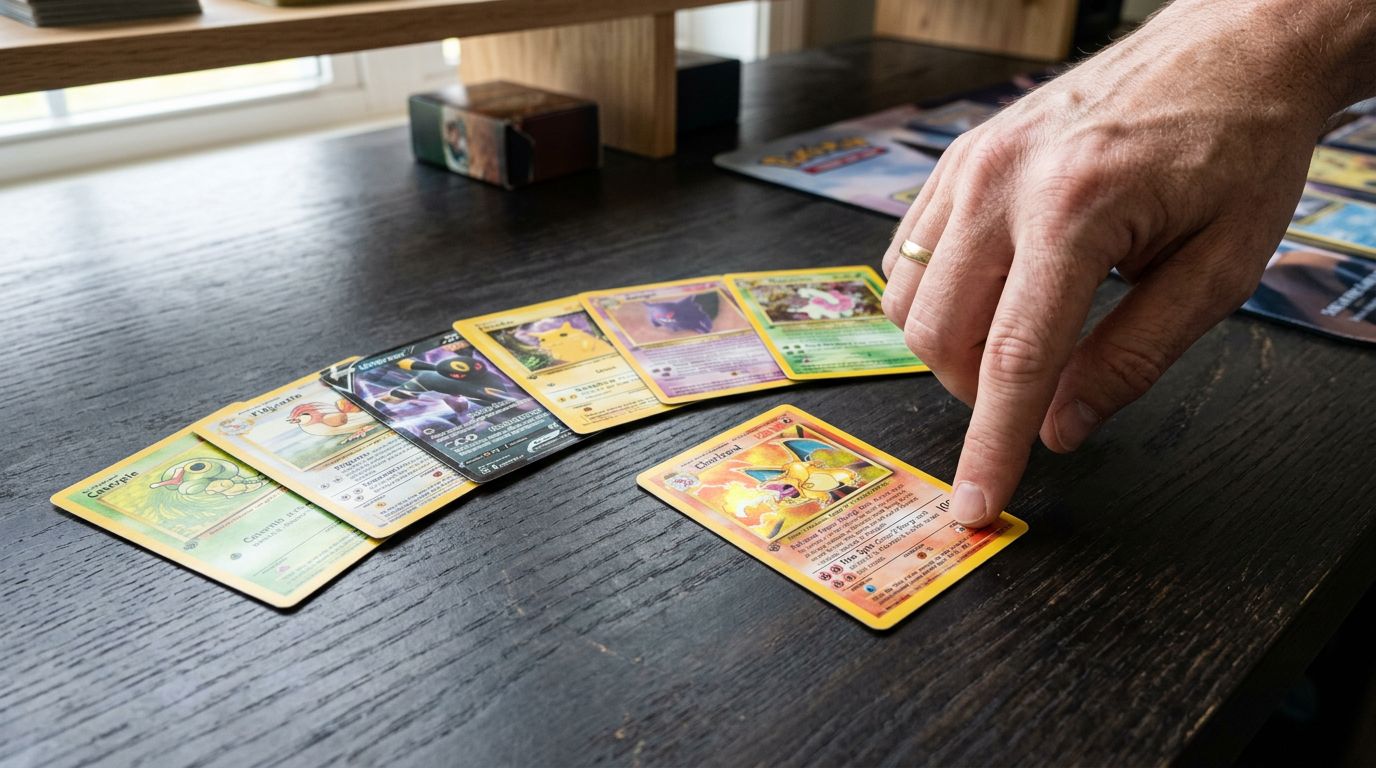
Pokemon card rarity symbols are one of the first things collectors learn to check. They tell you whether a card is common, uncommon, rare, or part of a harder-to-pull modern rarity tier. But rarity symbols can also confuse beginners because Pokemon has changed its rarity system over time.
Older cards use simple shapes like circles, diamonds, and stars. Modern Scarlet & Violet-era cards use labels such as Double Rare, Illustration Rare, Special Illustration Rare, Ultra Rare, and Hyper Rare. Japanese cards may use letters instead of the exact same English symbols. Promo cards follow their own numbering. Some special sets add unique treatments.
This guide explains the major Pokemon card rarity symbols and what they mean for collectors.
On most Pokemon cards, the rarity symbol is near the bottom of the card, usually close to the card number and set information. On older English cards, you will often see a small black circle, diamond, or star. On modern cards, you may see one or more stars in different colors or a rarity label connected to the card type.
The bottom of the card is where you should check:
The rarity symbol is only one part of identification. Always combine it with the set name, card number, language, holo treatment, and variant.
Common cards traditionally use a circle symbol. These are the easiest cards to pull from booster packs and usually make up much of a set. Common cards are often basic Pokemon, simple Trainer cards, or cards that support deck building.
Common does not automatically mean worthless. A common card can still be collectible if it has beloved artwork, features a popular Pokemon, is from an old set, has a special variant, or is in unusually clean condition.
Still, most modern common cards have low market value unless they are playable, part of a special print, or tied to a desirable character.
Uncommon cards traditionally use a diamond symbol. They are less frequent than common cards but still appear regularly. Uncommons often include evolved Pokemon, stronger Trainer cards, special Energy cards, or useful deck pieces.
Like common cards, uncommon cards are not usually expensive by rarity alone. But some uncommons become desirable because they are competitively useful, vintage, low-population in high grade, or connected to an iconic Pokemon.
For collectors, uncommons matter because they fill binders and complete sets. For players, they can matter because the best deck-support cards are not always rare.
Rare cards traditionally use a star symbol. In older sets, rare cards could be non-holo rares or holo rares. The star told you the card was rare, while the foil treatment told you whether it was a holographic rare.
This is an important distinction. A rare card is not always a holo card. A holo card is not always more valuable than every non-holo card. Value depends on the exact card, demand, condition, print run, set, and market history.
Vintage rare holos are often desirable because they combine character demand, age, nostalgia, foil treatment, and condition scarcity. Modern rare cards can be easier to pull and may not carry the same premium.
Holo and reverse holo are treatments, not always separate rarity levels.
A holo rare usually has a shiny holographic artwork box. A reverse holo usually has shine on much of the card outside the main artwork area. In many eras, cards across different rarity levels could have reverse holo versions.
That means a reverse holo common is still a common card, but it is a reverse holo version of that card. A reverse holo rare is a reverse holo version of a rare card.
Collectors should track both rarity and treatment:
The exact version matters when pricing or completing a master set.
In the Scarlet & Violet era, Double Rare is commonly associated with Pokemon ex cards and is shown with two black stars. These cards are above standard rare cards and are often more exciting pulls, but they are usually not the top collector chase in a set.
Double Rare cards can still matter. A popular Pokemon ex, a competitively useful card, or a clean copy in a high grade can be desirable. But collectors should not assume every Double Rare is expensive.
Think of Double Rare as an important modern rarity tier, but not automatically a premium chase.
Illustration Rare cards are one of the most collector-friendly modern rarity types. They usually feature full-card artwork with a strong visual scene. Many collectors love them because they feel more like art pieces than standard game cards.
In Scarlet & Violet-era English sets, Illustration Rare cards are generally marked with a single gold star. These cards often feature regular Pokemon rather than only the biggest competitive cards.
Illustration Rare cards can be valuable when the artwork is loved, the Pokemon is popular, the card is hard to pull, or the set becomes collectible. But the best reason to collect them is simple: they look good in binders.
Special Illustration Rare cards are a higher modern chase tier. They often feature premium artwork for Pokemon ex, important Trainers, or major characters. In English Scarlet & Violet-era sets, they are generally marked with two gold stars.
Special Illustration Rare cards can become major chase cards because they combine:
These are often the cards collectors notice first when a modern set launches. Still, value can change after release hype settles, so always check recent sold prices.
Ultra Rare is a term that has existed in different forms across Pokemon TCG eras. In modern Scarlet & Violet-era English sets, Ultra Rare cards are generally marked with two silver stars and often include full-art Pokemon ex or Supporter cards.
Older eras used different ultra-rare categories, including EX, GX, V, VMAX, VSTAR, Full Art, Rainbow Rare, Gold cards, and more. This is why collectors should not use one definition for every era.
When someone says Ultra Rare, ask which era and which card. The symbol, set, number, and treatment matter more than the broad phrase.
Hyper Rare is a high modern rarity tier. In Scarlet & Violet-era English sets, Hyper Rare cards are generally marked with three gold stars and are often gold-style cards.
Hyper Rare cards can feel premium because of their finish and low pull frequency, but they are not always the most valuable cards in a set. Sometimes a Special Illustration Rare of a popular Pokemon sells for more than a Hyper Rare card because demand is stronger.
This is an important collector lesson: higher rarity does not always mean higher price.
In many Pokemon TCG eras, secret rares are identified partly by card numbers that go beyond the official set total. For example, a card numbered 205/198 is beyond the listed set size.
Secret rares often include premium treatments like gold cards, rainbow rares, alternate arts, or special full-art cards depending on the era. But the term can vary by set and generation.
Always check the card number. If the numerator is higher than the denominator, the card is outside the normal set numbering and may be considered secret or part of the premium section of the set.
Promo cards do not fit neatly into normal booster rarity. They are usually distributed through products, events, store promotions, tournament participation, special boxes, tins, elite trainer boxes, collection boxes, or other campaigns.
English promo cards often have promo numbering such as Black Star Promo cards. Modern Scarlet & Violet promos use SVP numbering. Older eras used other promo prefixes.
Promo value depends on distribution. A promo included in a widely available box may be common. A staff promo, event promo, tournament promo, or limited campaign card can be much harder to find.
Do not assume promo means rare. Ask how the promo was distributed.
Japanese Pokemon cards often use letter-based rarity codes rather than the same exact English symbol presentation. You may see labels such as C, U, R, RR, SR, SAR, UR, AR, and other set-specific codes.
The exact Japanese rarity structure can differ from English releases. A Japanese card may release earlier, have different pull rates, different card stock, different set composition, and different collector demand.
If you collect Japanese cards, learn the rarity code for that set. Do not assume the English rarity system maps perfectly.
Some rarity symbols are tied to game mechanics or special card types. ACE SPEC cards, for example, have appeared in multiple eras and are connected to powerful gameplay effects and distinctive card treatment.
Other eras introduced mechanics such as Pokemon ex, EX, GX, V, VMAX, VSTAR, Tag Team, Trainer Gallery, Radiant Pokemon, Amazing Rare, Prism Star, Shining Pokemon, Gold Star, and more.
These are not all the same thing as simple rarity symbols. Some are gameplay mechanics. Some are collector treatments. Some are both.
When identifying a card, separate the layers:
This is the most important lesson in the article. Rarity helps explain supply, but value comes from supply plus demand.
A card can be rare and still cheap if collectors do not care much about it. A card can be common and still desirable if it is old, beloved, playable, misprinted, or in very clean condition.
Value is shaped by:
When pricing a card, rarity is the starting point, not the conclusion.
Rarity can help you decide whether a card is worth grading, but it should not be the only reason.
A Special Illustration Rare, vintage holo, secret rare, or scarce promo may be a better grading candidate than a common modern card. But condition still matters. A rare card with a dent, poor centering, or heavy surface scratching may not grade well.
Before grading, compare raw value, graded sales, grading fees, and realistic grade outcomes. If the card only makes sense as a PSA 10 or CGC 10, inspect it very carefully.
TOKIO is useful because collectors need more than a card name. They need context: what rarity it is, what condition or grade it has, what value range makes sense, whether it belongs in a vault, and what choices exist after the reveal.
Rarity is exciting during a pull, but the real collector question comes after: what did I get, why does it matter, and what should I do with it?
TOKIO’s graded-card and collection workflow fits that moment. It helps turn a reveal into something easier to understand, track, hold, sell, or redeem.
When you pull or inspect a Pokemon card, ask:
Pokemon card rarity symbols are a map, not a price tag.
They help you understand where a card sits in a set, how it was likely pulled, and why it might be more collectible than a standard card. But value still depends on demand, condition, grade, artwork, character popularity, and market behavior.
Learn the symbols, then look deeper. That is how collectors move from guessing to understanding.