Loading article
Loading page
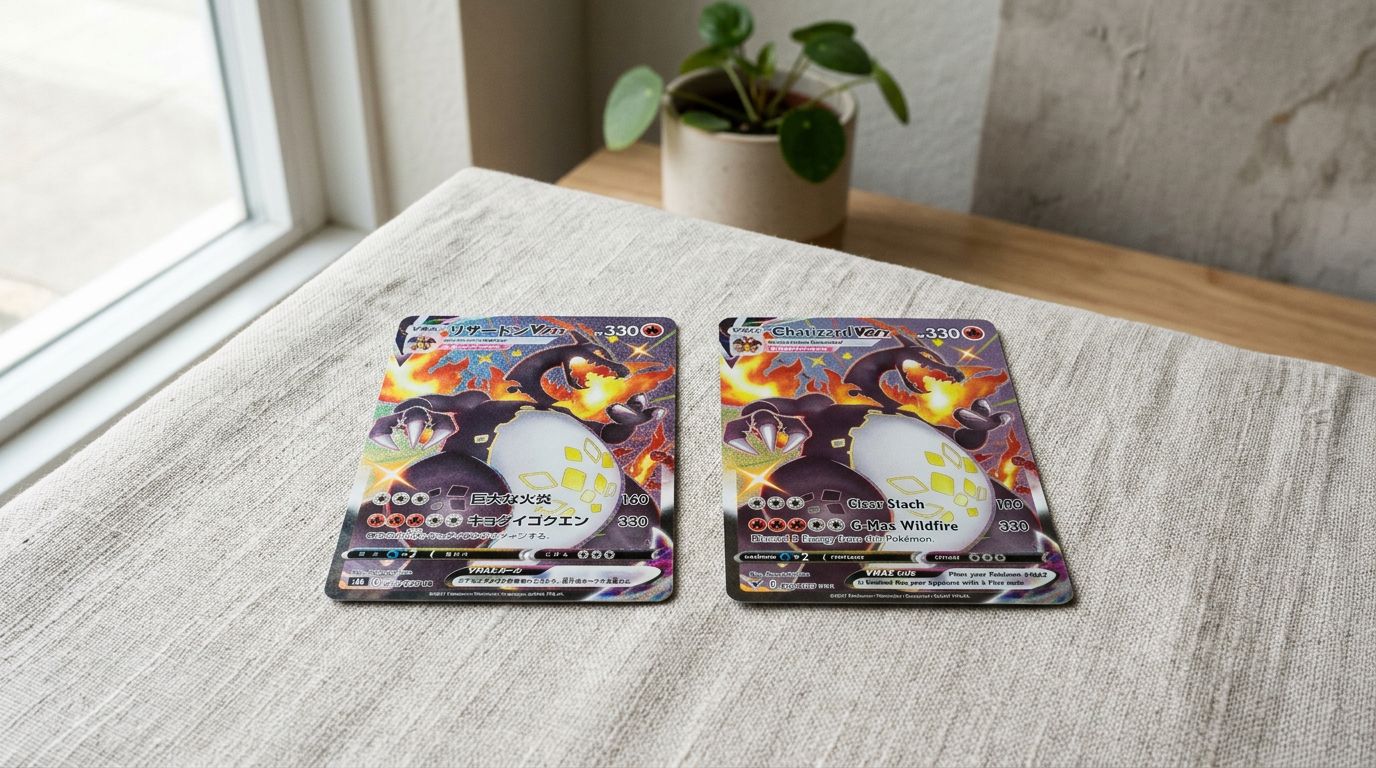
Japanese and English Pokemon cards can look similar at first, but collectors treat them differently. The artwork may be the same, but the language, release timing, product structure, print quality, grading population and resale market can all change how a card feels in a collection.
There is no universal answer to which one is better. The right choice depends on why you collect.
If you want the broadest resale market in the United States, English cards are often easier to move. If you care about original Japanese releases, exclusive promos, sharper print feel or lower entry prices on certain cards, Japanese cards can be more interesting.
An English Pokemon card is printed for English-language markets. A Japanese Pokemon card is printed for the Japanese Pokemon Card Game market.
Both are official Pokemon cards when they come from legitimate Pokemon products. The difference is not whether one is real and the other is fake. The difference is market, language, release structure and collector preference.
You can browse English Pokemon card information through Pokemon's English TCG resources, and Japanese card information through the official Pokemon Card Game card search. For price research, collectors often compare tools such as PriceCharting, TCGplayer, eBay sold listings and PSA Auction Prices.
Japanese cards have a strong collector identity because Pokemon began in Japan and many cards appear in Japanese before they appear in English.
Collectors often like Japanese cards for:
Japanese cards can feel closer to the source of the hobby. For some collectors, that matters. A Japanese promo, tournament card or exclusive product can feel more special than the later English equivalent, especially if there is no true English version.
English cards are usually easier for U.S. collectors to read, price and resell.
Collectors often like English cards for:
If your main market is the U.S., English cards often have the clearest demand. More buyers can read them, search for them and compare them quickly.
Japanese Pokemon cards often release before their English counterparts. English sets may combine cards from multiple Japanese products into one larger English expansion.
That matters because hype often begins when Japanese cards are revealed. Collectors may chase Japanese versions early, then English versions later when the English set releases.
This timing difference creates two kinds of collectors:
Neither approach is wrong. The risk with buying early Japanese hype is that prices can move fast once the English release is announced or once supply increases.
Many collectors believe modern Japanese cards often have strong print quality, cleaner edges and consistent texture. That reputation is one reason Japanese cards can be popular with grading-focused collectors.
But do not turn that into a rule. Japanese cards can still have print lines, centering issues, surface marks, whitening or factory flaws. English cards can also grade extremely well. Condition always depends on the specific card in front of you.
If you are buying raw cards, inspect:
The language does not protect you from condition risk.
Japanese and English versions of the same artwork can sell for very different prices.
Sometimes the Japanese version is cheaper because the English market has more demand. Sometimes the Japanese version is more expensive because it is an exclusive promo, has lower availability, released earlier or has a stronger collector story.
Before buying, compare the exact version. Do not assume the Japanese and English card should be priced the same.
Check:
Price tools such as PriceCharting can show raw and graded price references, while PSA Auction Prices can help with realized prices for PSA-graded cards.
Liquidity means how easy a card is to sell at a fair price.
In the U.S., English Pokemon cards are often more liquid because more casual buyers search in English, more sellers list in English and more collectors understand English set names immediately.
Japanese cards can still be very liquid, especially for popular Pokemon, exclusive promos, high grades and chase artwork. But the buyer pool may be more specialized. A Japanese card can be valuable and still take longer to sell if fewer buyers are actively looking for that exact version.
This is not a problem if you collect for enjoyment. It matters more if you plan to trade, resell or use cards as a value store.
Both Japanese and English Pokemon cards can be graded by major grading companies. PSA, CGC and Beckett all grade Pokemon cards across many languages and sets.
For graded cards, language affects demand. A PSA 10 Japanese card and a PSA 10 English card are not automatically equal. The market may prefer one version depending on the card.
Before buying a graded Japanese or English card, check:
The number on the label matters, but the language and version matter too.
For most U.S. beginners, English cards are easier to start with. The names are familiar, pricing is easier, local buyers understand them and set lists are simpler to follow.
Japanese cards are a strong second step once you know what you like. They are especially good if you care about artwork, promos, sealed Japanese products or building a collection that feels different from a standard English binder.
A beginner can collect both, but it helps to separate the goals:
Be careful with the word investor. Pokemon cards are collectibles first. Prices can move down, liquidity can dry up and hype can fade.
If you care about resale, English cards often have a simpler U.S. exit path. If you care about scarcity and uniqueness, certain Japanese promos or exclusive cards may have stronger collector stories.
The best card is not always the rarest. It is the card with the best mix of demand, condition, scarcity, authenticity and buyer depth.
Japanese cards make sense when:
Japanese cards are also excellent for focused collections. A Pikachu, Eevee, Charizard, Gengar or trainer collection can become more interesting when it includes Japanese promos and variants.
English cards make sense when:
English cards are especially practical if your collection is partly for trading. More people will understand what the card is without extra explanation.
Collect English cards if you want simplicity, readability and stronger U.S. liquidity. Collect Japanese cards if you want original-language appeal, unique promos, early artwork and a more specialized collection.
The strongest collection can include both. Use English cards for your core set or resale-focused cards. Use Japanese cards for art, promos and pieces that make the collection feel personal.